
In this project
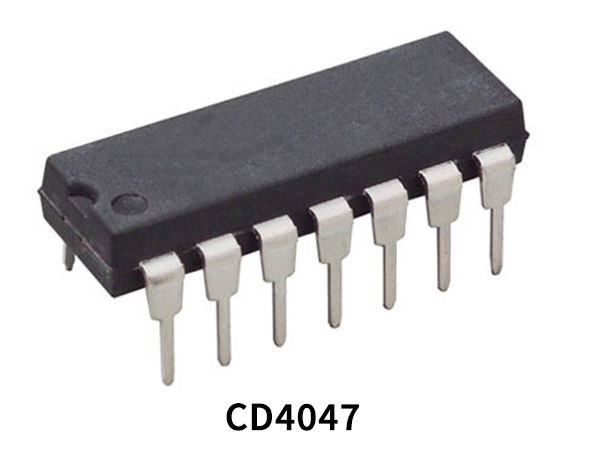
The CD4047B is capable of operating in either the monostable or astable mode. The IC is made by using the Complementary MOS (CMOS) technology, integrated with p-type and n-type enhancement moe transistors. It requires an external capacitor and an external resistor (between pins 2 and 3) to determine the output pulse width in the monostable mode, and the output frequency in the astable mode. Astable operation is enabled by a high level on the astable input or a low level on the astable input. Monostable operation is obtained when the device is triggered by LOW-to-HIGH transition at + trigger input or HIGH-to-LOW transition at − trigger input. The output of the IC always comes in TTL which makes it easy to work with other TTL devices and microcontrollers.
Monostable Multivibrator
A monostable multivibrator (MMV), often called a one-shot multivibrator, is a pulse generator circuit in which the duration of the pulse is determined by the R-C network, connected externally to the 555 timers. In such a vibrator, one state of output is stable while the other is quasi-stable (unstable). For auto-triggering of output from a quasi-stable state to a stable state, energy is stored by an externally connected capacitor to a reference level. The time taken in storage determines the pulse width.
Astable Multivibrator
An astable multivibrator is a free-running oscillator that switches continuously between its two unstable states. With no external signal applied, the transistors alternately switch from cutoff to saturation state at a frequency that RC time constants of the coupling circuit determine. If these time constants are equal (R and C are equal) then a square wave will generate with a frequency of 1/1.4 RxC. Hence, an astable multivibrator is also a pulse generator or a square wave generator.
CD4047 Key Features
- Wide supply voltage range: 3.0V to 15V
- High noise immunity: 0.45 VDD (typ.)
- Low power TTL compatibility: Fan out of 2 driving 74L or 1 driving 74LS
Special Features
- Low power consumption: special CMOS oscillator configuration
- Monostable (one-shot) or astable (free-running) operation
- True and complemented buffered outputs
- Only one external R and C required
Monostable Multivibrator
- Positive- or negative-edge trigger
- Output pulse width independent of trigger pulse duration
- Retriggerable option for pulse width expansion
- Long pulse widths possible using small RC components by means of external counter provision
- Fast recovery time essentially independent of pulse width
- Pulse-width accuracy maintained at duty cycles approaching 100%
Astable Multivibrator
- Free-running or gatable operating modes
- 50% duty cycle
- Oscillator output available
- Good astable frequency stability
- typical= ±2% + 0.03%/°C @ 100 kHz
- frequency= ±0.5% + 0.015%/°C @ 10 kHz
- deviation (circuits trimmed to frequency VDD = 10V ±10%)
CD4047 Pinout
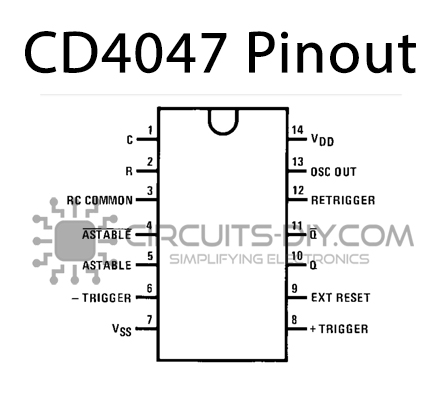
| Pin No | Pin Name | Description |
|---|---|---|
| 1 | C | connect external capacitor |
| 2 | R | connect external resistor |
| 3 | RC-COMMON | connecting resistor and capacitor |
| 4 | A-STB' | Low when used in Astable mode |
| 5 | ASTB | High when used in Astable mode |
| 6 | - TRIGGER | Monostable mode we give High to Low transition |
| 7 | VSS | source supply |
| 8 | +TRIGGER | Monostable mode we give Low to High transition |
| 9 | EXT RESET | Its an external reset pin |
| 10 | Q | high output |
| 11 | Q' | low output |
| 12 | RETRIGGER | Used in Monostable mode to simultaneously retrigger +trigger and –trigger pin |
| 13 | OSC-OUT | oscillated output |
| 14 | VDD | Drain supply |
Application
- Frequency discriminators
- Timing circuits
- Time-delay applications
- Envelope detection
- Frequency multiplication
- Frequency division
CD4047 Datasheet
You can download the datasheet for CD4047 Monostable/Astable Multivibrator IC from the link given below:
See Also: CD4555 Dual Binary 1 of 4 Decoder – Datasheet | CD40110 Decade Up/Down Counter – Datasheet | CD4503 Tri-state Hex Buffer – Datasheet

Discussion
Be the first to comment